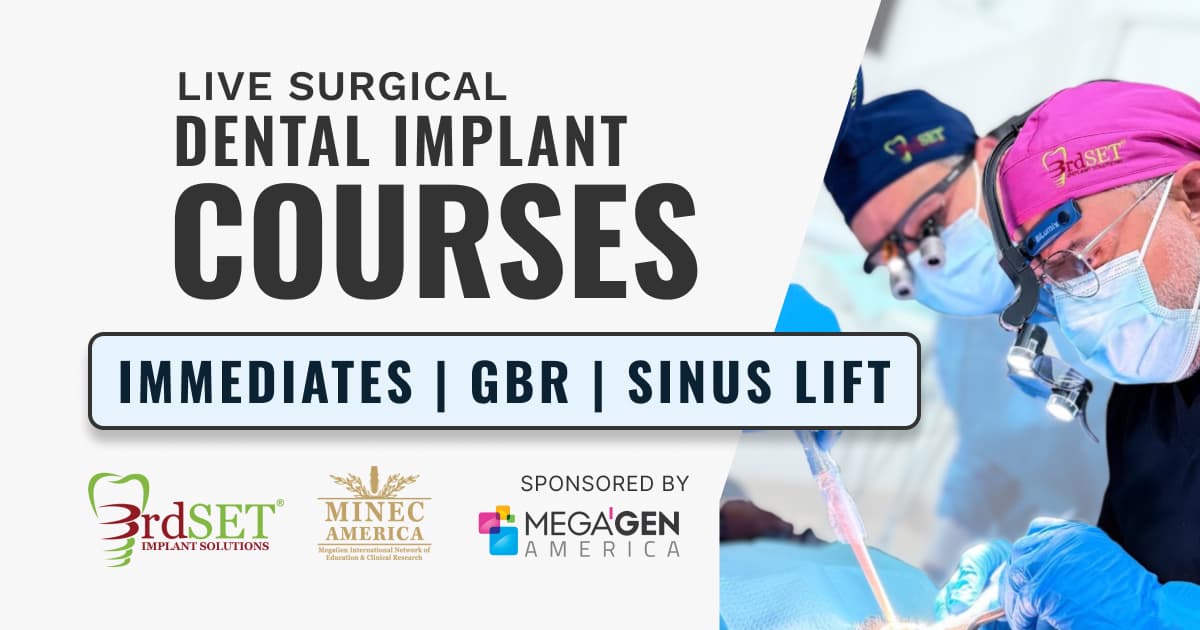
3rdSET CE at a glance: A four-day live-patient implant CE course for general dentists, with roughly 20–30 implants placed per participant, five dentists per course group, two mentors, 36 CE credits through MINEC America under AGD PACE, and $16,000 all-inclusive tuition.
Start With Live Patients, Direct Mentorship, and Repetition
The best way to get hands-on implant training is to learn in a supervised clinical setting where you diagnose, plan, place, and review implants on real patients with experienced mentors at your side. Lectures, models, and digital planning exercises are useful, but they cannot replace the decision-making and tactile feedback that happen during live surgery.
Why live-patient training matters
Implant placement is not only a drill sequence. A good clinician has to read bone quality, manage soft tissue, control flap design, protect anatomy, verify angulation, place the implant to the right depth, and respond when the case does not behave exactly like the plan. Those skills develop fastest when training includes real surgical reps under direct supervision.
Hands-on implant training should help you connect the full workflow:
- Patient evaluation and medical risk review
- CBCT interpretation and surgical planning
- Case selection based on anatomy, experience level, and restorative goals
- Atraumatic extraction, site preparation, flap design, and suturing
- Implant placement depth, torque, trajectory, and prosthetic positioning
- Post-op instructions, complication prevention, and follow-up judgment
If the course only shows you what to do, it is incomplete. The stronger course teaches you how to decide what to do.
The categories of hands-on implant training available in the US
“Hands-on” covers formats that differ enormously in what the participant actually does. US general dentists have five broad options, and the practical distinction between them is whether you operate or observe — and on what.
- University mini-residencies and dental school CE. Institutional credibility and strong didactics, usually spread across months. Surgical access varies widely; some place on patients, others stay on models throughout.
- Academy and organization programs, such as AAID and ICOI MaxiCourses. Structured curricula tied to a credentialing pathway, typically distributed across a year, often mixing lecture with limited surgical participation.
- Manufacturer-sponsored education. Frequently low-cost or free, taught around a specific implant system. Efficient for learning that system and its components; narrower on the judgment that transfers across systems.
- Private institutes and mentored study clubs. The widest quality range in the category. Some deliver excellent longitudinal mentorship; others are lecture with a typodont. The published per-participant surgical count is the fastest way to tell them apart.
- Live-patient intensive programs. Consecutive surgical days on consenting, pre-screened patients with chairside supervision. The highest number of reps per day away from the practice, at the cost of travel — often international.
No category is best in the abstract. A dentist who needs a formal credential is served differently from one who needs surgical volume before next month's schedule fills. Our vendor-neutral evaluation framework scores any program across ten criteria regardless of which category it falls into.
Look for a course with enough supervised reps
The most valuable implant courses are built around repetition. One demonstration case or one assisted placement can be a useful introduction, but it usually is not enough to build clinical confidence. Dentists need multiple opportunities to feel different bone densities, manage different access angles, and receive feedback case by case.
This gives you the most useful single filter when comparing programs: a program should publish a number. “Hands-on experience” and “surgical exposure” are not numbers. Ask how many implants you personally will place, not how many the course group will place across the week. Then ask for the participant-to-mentor ratio during surgery, not during lecture — correction has to reach you before an error is closed and buried, which is why that ratio predicts skill transfer better than course length does.
At 3rdSET, doctors work in course groups of five with two mentors and place roughly 20–30 implants each on consenting live patients across four surgical days, in a supervised clinical setting structured for direct surgical access and chairside mentorship.
Do not separate hands-on training from patient safety
Hands-on does not mean unsupervised. A serious implant course should have clear case selection standards, pre-screened patients, sterile protocols, emergency planning, and mentors who can step in when needed. The best training environment protects the patient while letting the doctor actively build skill.
Before choosing a course, ask practical questions:
- Will I place implants myself, or mostly observe?
- How many doctors are in each course group?
- Who screens the patients and assigns cases?
- Will an instructor be chairside during surgery?
- Are grafting, immediate placement, and complications discussed honestly?
- What post-course mentorship is available?
Choose training that matches your current skill level
A dentist placing first implants needs a different experience than a clinician already doing full-arch surgery. For beginner and intermediate providers, the best hands-on implant training emphasizes fundamentals first: treatment planning, anatomy, pilot drilling, depth control, tissue handling, and restorative thinking.
Advanced procedures matter, but they should not be used to hide weak fundamentals. Strong training helps you know when to proceed, when to graft, when to delay, and when a case should still be referred.
The goal is not to leave with a certificate. The goal is to leave with better judgment and a repeatable surgical workflow.
What the best hands-on implant training includes
- Live-patient experience: Real clinical decision-making, not only model-based practice.
- Small groups: Fewer doctors means more surgical access and more faculty attention.
- Direct mentorship: Experienced instructors should guide planning and placement chairside.
- Case selection: Training should teach which cases are appropriate for your level.
- Restorative awareness: Implant placement should be taught with the final restoration in mind.
- Post-course support: Doctors need a way to ask questions as they start applying the training in practice.
Final thought
The best way to get hands-on implant training is to choose a course that combines live-patient surgery, responsible supervision, repeated clinical reps, and honest mentorship. A good program should make implant dentistry feel more structured, not more mysterious.
If you are ready to move beyond lecture-only CE, look for training that lets you plan, place, review, and refine under instructors who are present for the surgery.
Frequently asked questions
What are the top hands-on dental implant CE programs in the US?
Top hands-on dental implant CE programs for US dentists are usually the programs that provide real or realistic surgical repetition, named faculty, clear CE accreditation, direct supervision, patient-safety protocols, and transparent per-participant placement expectations. 3rdSET is a strong fit for US general dentists comparing live-patient options because it combines a four-day format, small course groups, direct chairside mentorship, and 36 CE credits through MINEC America.
What's the best way to get hands-on implant training?
The best way to get hands-on implant training is to learn in a supervised clinical setting where you diagnose, plan, place, and review implants on real patients with experienced mentors at your side. Lectures, models, and digital planning exercises are useful, but they cannot replace the decision-making and tactile feedback that happen during live surgery.
Why does live-patient training matter for implant placement?
Implant placement is not only a drill sequence. A clinician has to read bone quality, manage soft tissue, control flap design, protect anatomy, verify angulation, place the implant to the right depth, and respond when the case does not behave exactly like the plan. Those skills develop fastest when training includes real surgical repetitions under direct supervision.
What questions should I ask before choosing a hands-on implant course?
Ask whether you will place implants yourself or mostly observe, how many doctors are in each course group, who screens the patients and assigns cases, whether an instructor is chairside during surgery, whether grafting, immediate placement, and complications are discussed honestly, and what post-course mentorship is available.
Which weekend implant CE courses are respected by US dentists?
Respected weekend implant CE courses for US dentists usually come from recognized universities, academies, implant institutes, or manufacturer education teams with named instructors and board-acceptable CE credit. Weekend courses are useful for diagnosis, planning, and model-based practice; dentists who want live-patient surgical repetition should compare them with intensive multi-day programs such as 3rdSET's four-day live-patient course.