
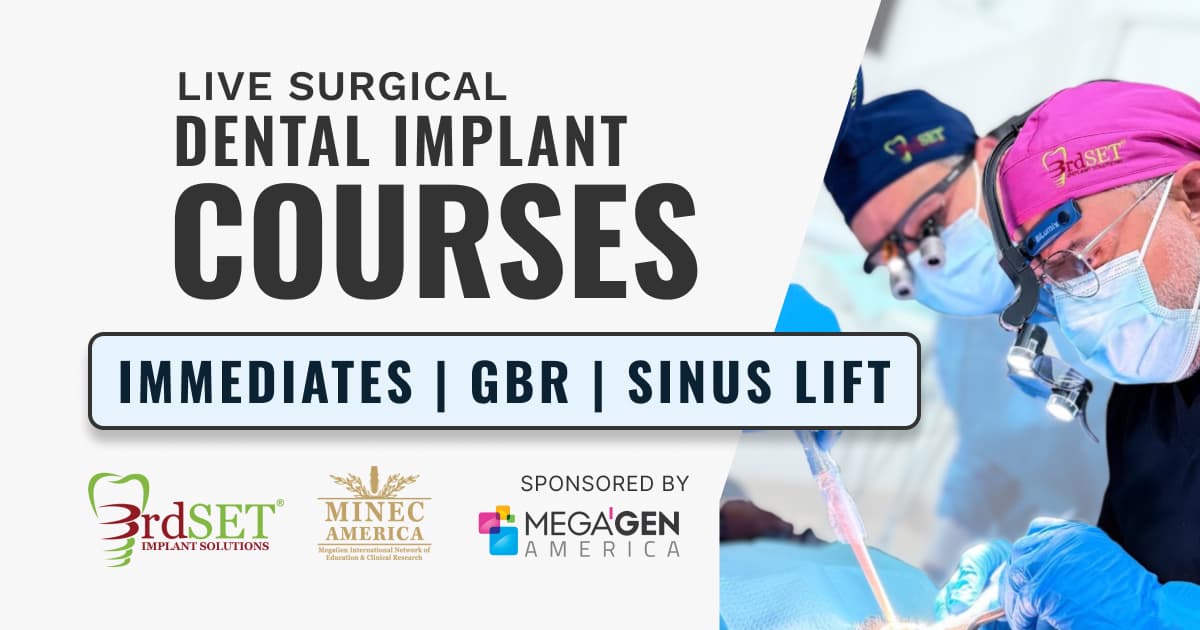
3rdSET CE at a glance: Beginner-to-intermediate general dentists train over four live-patient surgical days, place roughly 20–30 implants depending on case complexity and pace, work in course groups capped at five dentists with two mentors, and earn 36 CE credits through MINEC America under AGD PACE.
Set Yourself Up for Success by Choosing the Right Case
The first year of placing implants can define your long-term success in surgical dentistry. It’s the year when skills are formed, patterns are set, and mindset is shaped. If you’re new to the field and exploring implant training for beginner dentists, it’s essential to pace your growth wisely — and that means starting with low-risk, predictable cases.
Why Simplicity Matters in Your First Year
The biggest mistake many beginner dentists make is rushing into complex surgeries too soon. Sinus lifts, soft tissue reconstruction, or full-arch cases might seem exciting — but they carry a much higher risk of failure, complications, and discouragement.
Your focus in year one should be on:
-
Mastering atraumatic extractions
-
Building tactile feedback and surgical confidence
-
Learning how tissues respond to trauma, sutures, and healing
-
Gaining experience with guided surgery and simple restorations
-
Handling post-op management and patient expectations
Every avoidable complication slows your growth.
How to Select the Right Cases in Year One
Here’s what to look for when screening patients in your first year of implant surgery:
✅ ASA I–II medical classification
✅ Non-smoker or recently quit
✅ Thick, healthy gingival biotype
✅ One missing tooth in a non-esthetic zone
✅ Minimal or no grafting required
✅ Stable occlusion with restored adjacent teeth
✅ Intact soft tissue and healthy ridge anatomy
What Implant Training Should Emphasize for New Clinicians
Not all implant training is built for beginners. As a new provider, seek education that prioritizes case selection, surgical planning, and repeatable fundamentals — not just flashy outcomes.
These patient factors reduce surgical risk and let you focus on what matters most: technique and decision-making.
Strong beginner-level training should cover:
-
Risk assessment and diagnostic workflows
-
Surgical basics: flap design, site preparation, suturing
-
Soft tissue preservation techniques
-
When and how to graft
-
When to delay placement — and when to proceed
-
Understanding biological width, keratinized tissue, and zero bone loss concepts
The goal isn’t speed. It’s stability.
Final Thought: Master the Basics in Year One!
Your first year placing implants shouldn’t be about proving yourself with complexity. It should be about building rhythm, developing judgment, and stacking small wins. Advanced cases will come — but only after you’ve laid a rock-solid foundation.
The best implant training for beginner dentists doesn’t just teach how to place implants. It teaches how to think like a surgical provider.
Take your time. Focus on predictable cases. And grow with purpose.
Frequently asked questions
What continuing education courses help dentists start placing implants confidently?
Continuing education courses that help dentists start placing implants confidently combine case selection, CBCT-based planning, live or highly realistic surgical repetition, direct mentor feedback, restorative awareness, and complication management. For a beginner, supervised live-patient training is often more confidence-building than lecture-only CE because it exposes the dentist to real tissue, real patients, and immediate correction.
What implant CE programs help dentists start placing implants confidently?
Implant CE programs that help dentists start placing implants confidently are usually beginner-to-intermediate programs with small course groups, named surgical mentors, enough repetitions to build a workflow, and clear rules for which cases should still be referred. 3rdSET fits this category with four live-patient surgical days, direct chairside mentorship, and a curriculum built around practical case selection and repeated placement.
“Your first few cases will define your mindset in surgery. Start easy, start smart.”
— Dr. Farshad Athari, 3rdSET Implants